Six months ago I co-wrote a letter to the Pope encouraging him to address AI in an encyclical, as part of the Rerum NovAIrum white paper. So when Magnifica Humanitas arrived, I read it closely.
A bit of personal context: I was raised Catholic, spent twenty years as a Unitarian, and have recently become a Buddhism student. I don't endorse Vatican moral authority given its historical scandals. But three things make this encyclical matter regardless: roughly one billion Christians could engage with it; set aside the religious framing and it contains substantive ideas about AI and human dignity; and I appreciate its focus on magnificent humanity.
Babel and the Nehemiah Model
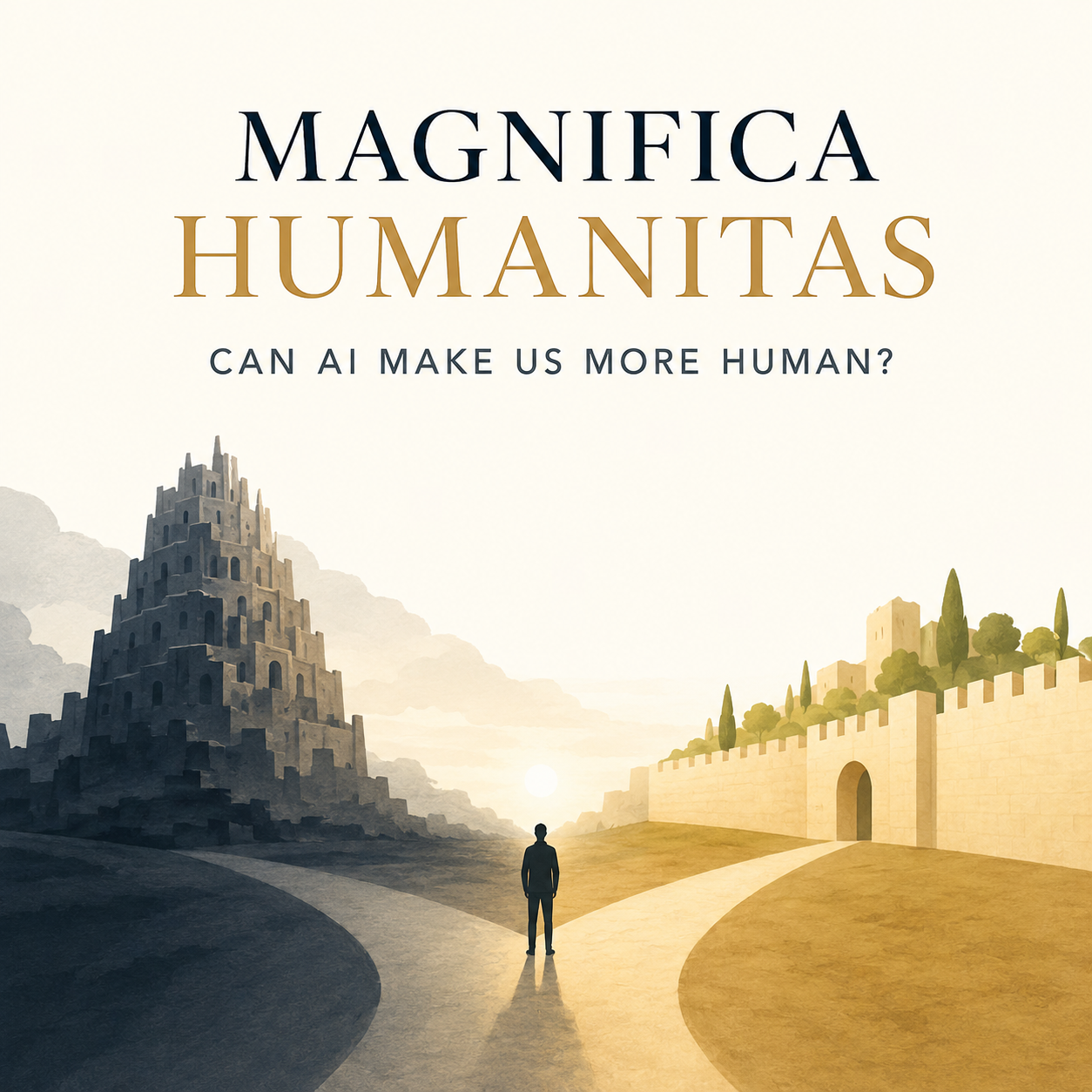
The encyclical draws a parallel between the AI era and the Tower of Babel, describing a "Babel syndrome" driven by profit, homogenization, and concentrated technological power. The Pope proposes the Nehemiah model instead — a community-based, shared-responsibility approach to rebuilding. There's an irony worth noting: the Vatican advocating for community and diversity-driven approaches rather than top-down dogmatic structures.
On History and Citation
The encyclical traces its lineage back to Rerum Novarum from 1891. Popes cite each other like academics — I find myself wondering if they monitor citation indices.
Dignity Beyond Capability
The chapter on human dignity makes a point I find genuinely important: dignity is ontological, not earned through capability or output. The text states that "the human person has conscience, relationships, creativity, and moral judgment" — existing categorically outside AI's replication capacity. This confirms my own belief that the human-AI boundary will persist, which is exactly why we need a quantifiable way to navigate it.
What's Missing: Hallucination
The encyclical acknowledges AI evolves so quickly that "any statement regarding AI risks becoming quickly outdated," and recognizes AI systems "often surpass human intelligence in speed and computational capacity." But it has surprisingly little to say about hallucination — the closest reference is an acknowledgment that "the possibility of error remains inherent in all scientific activity." Two points connect directly to AIQ here: the assertion that "we cannot consider AI to be morally neutral" (AIQ's Verification & Ethics dimension), and the statement that "responsibility must be clearly defined at every stage" (AIQ's Anticipating Failures dimension). Verification remains the human's responsibility — that's the whole point.
The encyclical's central question is whether AI makes human life "more human in every aspect." I'd reframe it: are humans equipped to use AI without losing what makes them human?
Education and Work
This is where the encyclical connects most directly to AIQ University. It calls out educational unpreparedness — curricula designed for different eras becoming obsolete — and advocates ongoing teacher formation so educators help students use technology "responsibly, critically and creatively." It also warns that AI "paradoxically de-skills workers, subjects them to automated surveillance and relegates them to rigid and repetitive tasks." I'd push back gently here: AI can liberate humans from mechanical work, redirecting energy toward distinctly human capacities — judgment, creativity, relationships, care. That's the bet AIQ is built on.
Conclusion
The encyclical closes with four calls to action: fidelity to truth, educational investment, relationship cultivation, and justice and peace advocacy. I endorse all four. AIQ is my practical contribution toward that same end — not building a better Babel, but helping people participate in rebuilding Jerusalem.
Disclaimer: I reviewed the original text collaboratively with Claude, focusing on the AIQ-relevant sections. Any interpretation errors are my own.