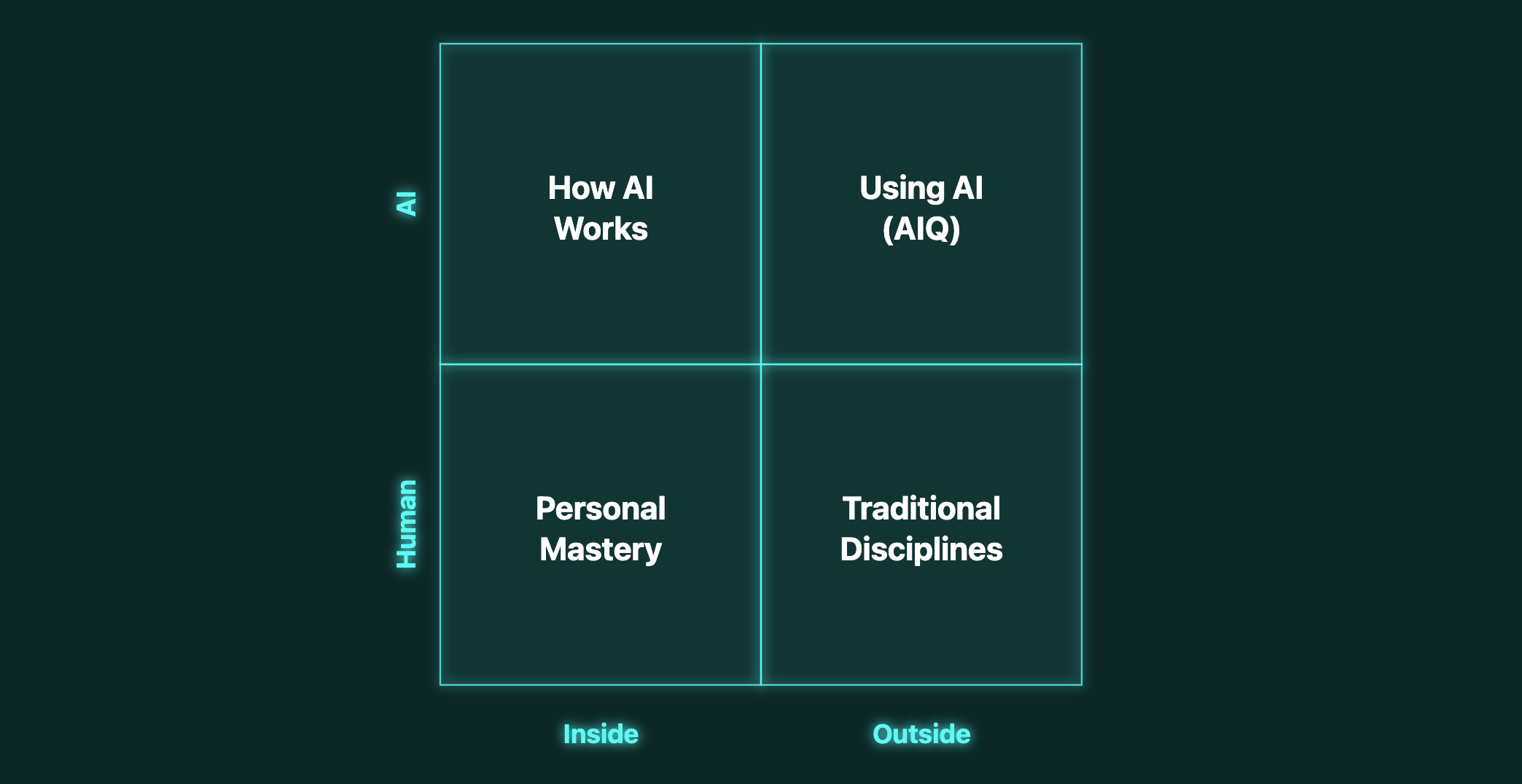
One criticism of AIQ University lands harder than the rest: how can a curriculum keep pace with AI? Here's the answer, organized around a two-by-two matrix. The vertical axis runs from Human (bottom) to AI (top). The horizontal axis runs from Inside (left) to Outside (right). Inside means understanding internal mechanisms; Outside means external interactions and applications.
Understanding AI's technical foundation: neural networks, learning algorithms, backpropagation, large language models, self-attention and transformer mechanisms. Technical tracks get mathematical rigor; non-technical programs get conceptual understanding. The goal is demystifying AI so professionals can navigate its limitations.
Practical AIQ mastery — effective AI application across context awareness, prompting, anticipating failures, verification, ethics, and workflow integration. This goes beyond prompt engineering to discipline-specific professional judgment, ensuring AI augments rather than replaces skilled practitioners.
The most critical and overlooked quadrant. Self-awareness, emotional intelligence, leadership, agency, ethics, judgment — skills AI cannot replicate. Development requires experience, practice, and human friction, which is why in-person learning is essential here.
Traditional academic disciplines remain central — law, medicine, engineering, business. The pedagogical shift emphasizes deep understanding over memorization: medical students learn physiological systems to collaborate with AI agents; law students develop judgment rather than memorizing cases.
Expiring Credentials
The curriculum continuously evolves, especially in the AI quadrants. Graduates must periodically return to recalibrate their knowledge, ensuring credentials remain relevant to the advancing frontier — not a one-time certification, but an ongoing relationship with the institution.